Change Reflux Disease


During my working years I was frequently bothered with night-time acid reflux. Given the stresses of work and life, along with poor eating and exercise habits, I guess that’s not an unexpected consequence. In any case, one night last year, as I sat chewing two extra-strength antacid tablets in an attempt to soothe the burning in my chest, it struck me that there was a leadership analogy to this ailment that might be worth exploring.

Since I was already awake and needed to stay vertical for a while anyway for the antacids to do their thing, I figured I might as well think this through, and write it down. I decided that if, the next morning, I could read what I’d written that night, and it still made sense, I’d pass it along in a blog. It did, so I shared it with my colleagues then, and now I’m sharing it with the rest of the world.

We’re living and working in a time that requires us to process and implement a seemingly endless stream of changes. If our business leaders aren’t wise in the way they prepare for, or the way they ask the workforce to digest (starting to get the analogy?) these changes, the organization will develop “Change Reflux Disease”. Without getting too graphic, change reflux disease is the pushback that comes as a result of forcing people to take on too much change, implementing the wrong kind of changes, and/or choosing the wrong time to implement the changes. And, just like acid reflux disease, change reflux disease causes damage. It makes people miserable, keeps them up at night and dilutes their productivity.

So, if you’re leading the implementation of a change in your business, step back and take a systems thinking and human factors approach. Take a hard look at the magnitude and timing of the changes you’re trying to implement, and the context in which you’re trying to implement them. Gaining that perspective, and making thoughtful adjustments to the implementation methods and tempo, will reduce the organizational reflux. The prescription for avoiding change reflux is to: 1) prepare people to accept change by openly communicating the thinking behind the change; 2) informally engage a broad spectrum of people in the planning the change; 3) instead of the usual, “Now Hear This” change announcement communications, adopt a more holistic approach that enables them to see the WIIFM (What’s in it for me).

Is it realistic to expect business managers to take this more enlightened approach to change implementation? Maybe not…but it is something I would expect business leaders to do.

Posted in Humor, Leadership, That's Life | Tagged , , | 2 Comments

Happiness, Hope and Business Strategy

It seems to me that business leaders should pay more attention to the state of mind of their workforce when they engage in strategic planning. Businesses are after all, a system, or a network of people who must interact in certain ways to achieve the objectives of the system while meeting its constraints. Knowledge, and its application, transfer and transformation throughout the network is what fuels the business. So…the performance of the business is dependent on how effectively and efficiently knowledge moves through the network from where it is to where it needs to be. It’s my opinion, supported by my personal experience, the experience of others and numerous research studies that a workforce that is happier, and more hopeful, will be significantly more productive and creative in their knowledge transformation interactions and that will improve the business bottom line. Business leaders who understand this idea, and integrate it into their strategic plans and actions, will not only have a more fulfilled workforce, they’ll see significant business performance and growth results. The following paragraphs illustrate my thesis.
How often have you heard the phrase “Hope is not a strategy” around your work-place? These words, originally by Benjamin Ola Akande, Dean of the Business School of Webster University, were included in a letter he wrote to President Obama in 2009, providing advice on how to handle the economic crisis. What he meant to convey was that hope is not enough; it must be accompanied by actions. Since then, I’ve observed that the phrase has been adopted by some business leaders to motivate their workers to be more action oriented. There’s nothing wrong with this of course, we want people to take action. However, I’m here to say that hope is …must be, an integral part of any successful strategy. Strategies are conceived and executed by people with the expectation of accomplishing some desired result. That sounds like “hope” to me. I’m not talking about irrational, exuberant, foundationless emotion, but a thoughtful positive confidence that our collective skills, experience and mutual support will resolve problems and uncertainties in our favor. Business leaders must appreciate and nurture hope and positivity in their people and partner it with an action bias for meaningful results.
In May 2011 TED Talk, Shawn Achor made a presentation called “The Happy Secret to Better Work.” In it he describes studies that show that 75% of job success is predicted by positivity, optimism, and social support. The happier our people are, the better they’ll perform and the better the business will perform. He also says that our conventional wisdom of work hard> be more successful > achieve happiness is in wrong and that what we should be doing is focus on being happier and more positive> which will improve our work > which will make us more successful. He goes on to offer three ideas for re-wiring the brains of our workforce to be more positive which include: a daily requirement for each person to cite 3 positive things in their lives; making time and facilitating meditation as a positivity building activity; and promoting the practice of daily random acts of kindness.
Finally, in a blog on the Psychology Today Website, “Smiling at Strangers,” by Alex Likerman, M.D., the author tells a story of the power of smiling at strangers and how it builds new and positive attitudes. Studies show that the physical act of moving the muscles of our face to smile, introduces changes in brain chemistry that makes us happier. Studies also show that when we smile at people, their brains are wired to smile in response. Smiling and happiness are “infectious.”

Posted in Leadership | Tagged , , , , | 2 Comments

Project Management Across the Knowledge Domain

This is third in the series of my blogs addressing the intimate relationship between Project Management, Risk Management and Knowledge Management. In the first blog, I introduced the idea that the Project Manager must be a Knowledge Manager to be most effective in their job. In the second blog I highlighted the pervasiveness of knowledge management within the project manager’s responsibilities and throughout the project life cycle.

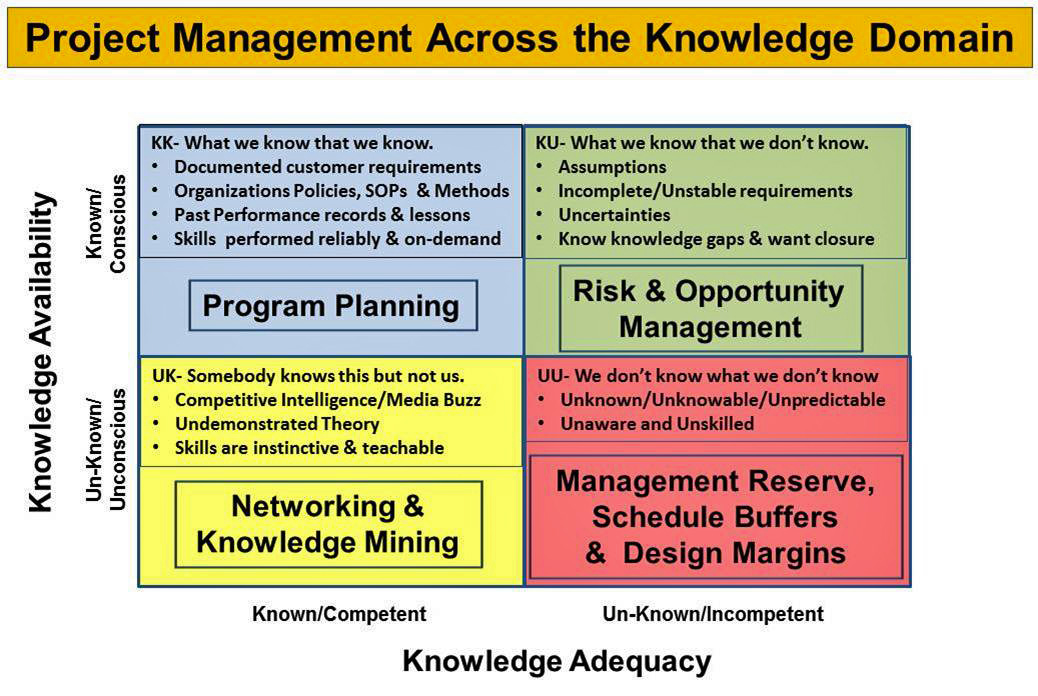
In this blog I’ll describe my views on how Project Managers, whether they realize it or not, execute most of their responsibilities, within and across the quadrants of what I’ll refer to as the “knowledge domain.” My thoughts in this regard are influenced by the concepts of the “Conscious Competence Learning Model”(CCLM), and the terminology, Known-Knowns (KK)”, Known-Unknowns (KU),” Unknown-Knowns (UK)”, and “Unknown-Unknowns (UU)”, apparently coined by former U.S. Secretary of Defense, Donald Rumsfeld. What I’m offering here is a map of the activities that project managers are, or should be engaged in, to the knowledge domain quadrants defined by these concepts and terms. The figure below depicts the four quadrants, mapped to a vertical axis of Knowledge Awareness and a horizontal axis of Knowledge Adequacy. Knowledge Awareness refers to the degree to which the project manager and the team know of, or are conscious of all of the available knowledge relevant to their project. Knowledge Adequacy refers to the degree to which the project manager and the team have competency in all of the knowledge required to execute their project.

In Project Management, the Known-Known (KK)/Conscious-Competence quadrant is where all of the known, relevant knowledge resources and expertise required to execute are identified, logic-linked and sequenced in a Project Plan.

Projects manage risks and opportunities related to lack of or uncertainty of knowledge in the Known-Unknown (KU)/Conscious-Competency quadrant. Decisions made in this quadrant are used to update the project plan and the resource allocations.

I’ve not seen much in the Project Management literature on the Unknown-Known/Unconscious Competence quadrant, but I think it must be recognized as one of the necessary knowledge management responsibilities of a Project Manager. Intellectual and fiscal resources must be planned and allocated to ensure that the project team is doing the right things to pursue and internalize additional relevant knowledge wherever it may exist. This means that one of the responsibilities of a project team must be to function as a learning organization. Knowledge acquired through these efforts will bolster the Known-Knowns area, reduce the risk in the Known-Unknowns area, and might even shine a bit of light into that dark corner of Unknown-Unknowns.

Projects attempt to protect themselves from the ravages of the Unknown-Unknown (UU) quadrant by building management reserve, schedule buffers and product design margins into the project baseline plans in an attempt to accommodate the “unknowable’s” and “unpredictable”.

In going through this thinking process, I realized that in addition to the similarities between the individual learning process described in the CCLM; and the goals and processes of Project Management, there are also some interesting differences that might be worth pursuing in a future blog. In the CCLM, the beginning state is “Unconscious-Incompetence” (unaware and unskilled)/UU, and the goal is to move through the other states to get to the “Unconscious-Competence” (skill is instinctive)/UK state. Projects, on the other hand, start with the “Conscious Competence”/KK state, and although they recognize the there is an “Unconscious-Incompetence”/UU quadrant, and they try to protect themselves from its ravages, they hope never to go there.

Thinking through and writing this blog has been a helpful learning process for me, even though I’ll admit it’s a bit of a convoluted read. However, if you’re in to Project Management or learning theory, I hope you stuck through it to the end and would be willing to share your professional feedback.

Posted in Program & Knowledge Management | Tagged , , , | 6 Comments

Does Good Luck Trump Good Planning?

Best Laid Plans

Your plan said you’d do what you should,

And you did the best that you could.

But when the going got tough,

And it still wasn’t enough.

It was better to be lucky than good

                                                                                  Don McAlister, January 1998

Posted in Humor, Program & Knowledge Management | Tagged , , | Leave a comment

Yawning – Sleepy, Bored or a Hot Brain?

One of my favorite places to look for topics of interest and learning value is the Psychology Today Web-site.  Not long ago I noticed a blog called “Why Do You Yawn When You’re Not Sleepy” by Faith Brynie, published in the Brain Sense category of the web-site. It offered a very interesting discussion of this most universal human behavior and referenced recent research that suggests that the causes of yawning may go beyond conventional wisdom. One of the things I like to do with new ideas or information is to explore them in a different context, and so I started thinking about yawning in the business context, with the following result.

The context– You’re giving a presentation at work to a large group of people, and someone yawns, then someone next to them yawns, and soon you see several other members of the audience stifling their yawns. Watching all of this, suddenly even you feel the urge to yawn. What’s going on? Did they only serve decaf coffee at the cafeteria this morning and everyone is falling asleep? Well according to this article, which is based on numerous neuroscience studies and research projects, while it’s definitely possible that your audience is sleepy, there are also other potential explanations. Unfortunately for you, one possibility is that your presentation is universally, and mind-numbingly boring.  Studies have shown that yawning is an involuntary act triggered by the release of a brain chemical that is produced when a human being is captured in what they perceive to be an extraordinarily boring environment. The good news is that studies have also confirmed what all of us have experienced throughout our lives…that yawning is highly contagious. So your presentation may only be really boring to one person and the all of the other yawns have been triggered the first one.

Experts believe that yawning may be hardwired into our brains and that it evolved as a form of human communication to coordinate behavioral responses to changes in our environment. Further studies show that people who scored higher on the “empathy” scale in personality tests, were more likely to yawn in response to seeing others yawn.

But wait there’s more… A new theory coming from researchers at Princeton and the University of Maryland says that yawning helps to regulate the temperature of our brains by inhaling and processing additional cool air through our sinus cavities. They believe that this may explain why we evolved to have sinus cavities, which otherwise don’t seem to have any important function.

So, given all of that insightful information, here’s my work context take-away.  The next time you’re giving a presentation and members of the audience start to yawn, don’t worry…it might not be your fault. It could be just one guy who didn’t get enough sleep last night and a bunch of other people with empathetic personalities or hot brains.

Posted in Humor, That's Life | Tagged , , , | 2 Comments

“Project Dis-Integration”

One of the most critical and difficult parts of executing a complex product development project, is the integration of all of the stakeholders, tasks, resources, requirements, and management information. Project Integration ensures that objectives are understood and aligned; tempo is adequate and synchronized; and issues, risks and help needs are all communicated. All Project Managers struggle with this, and most do a reasonably good job at it. Some however don’t do it well, and perhaps worst of all, some deceive themselves into thinking they’ve got it together, when in fact they’re on the edge of disintegration. This limerick was inspired by that self-deception.

Project Integration?

There once was an organization,
Which had trouble with project integration.
It was system they sought,
But instead what they got,
Were components flying in close formation.

                                                                              Don McAlister, 20 November 1997

Posted in Humor, Program & Knowledge Management | Tagged , , , | Leave a comment

Worrying About Risk Management

I was recently asked for my thoughts on the relationship between “worrying” and risk management. I thought I’d share my response in this blog.

“Worry” is an emotional state, evoked in response to some condition we have, or might encounter. Our brains are wired for worrying, it’s a species survival skill. The motivation for our worries can be real or imagined, a present reality, or a future possibility, and they can be productive or very distracting and unproductive.

In risk management, we want to leverage productive “worrying” to make us more aware, vigilant and ready for action, but then govern that condition with rational thinking, logic, process and tools to make sound response decisions.

All too often I’ve seen risk statements that offer a vague description of a “worry,” that fails to focus on the specific condition that’s creating the threat. As you know if you’ve read my other blogs, I believe risk management must be treated as a knowledge management activity. Risk is what we don’t know, and what’s uncertain about, or might change, in what we do know, that could bring on harmful consequences. A risk statement then must rationally and objectively identify the lack of, uncertainty about, or instability in, the knowledge required to perform some activity and the potentially harmful effects. A clear risk statement then sets the stage for the subsequent analysis, which estimates the likelihood, consequence and detectability of the condition, which in turn enables informed decisions on, and implementation of, response actions.

In closing, I think it’s important to add that I believe this same kind of thinking is applicable to managing the “euphoria” associated with positive risks, or “opportunities.” This approach will enable better exploitation planning and implementation decisions for those situations as well.

Posted in Program & Knowledge Management | Tagged , , | Leave a comment

Creative Scheduling

Project Managers always face customer schedule pressures and drive their teams to be responsive.  Sometimes those responses can be very creative.

Creative Scheduling

A creative scheduler once remarked,

“Einstein’s Theory could improve my chart.”

“By accelerating the plan…”

To the speed of light if we can.”

“We could finish before we start.”

                                                                           Don McAlister, December 1997

Posted in Humor | Tagged , , | 1 Comment

Project Management from a Knowledge Management Perspective

This is the second in a series of three blogs that I’m be posting on the intimate relationship between Project Management, Knowledge Management (KM), and Risk Management. In the first blog, “The Interdependency of Project, Knowledge and Risk Management”, I made the assertion that there is an intimate relationship between the three disciplines. I also said that Project Managers are in fact Knowledge Managers, and further, that whatever role you have in an organization, understanding this interdependency will enable you to make more informed decisions and make you more effective in executing your job responsibilities.

In this second blog, I’ll try to illustrate the pervasive nature of knowledge management activities within the responsibilities of a Project Manager (PM). To do this, I’m going to provide a fairly detailed summary of what I view as the knowledge management activities that a PM must engage in throughout the life cycle of a project. I’m highlighting those KM activities by using a bold italics font. I hope, in this way to convey just how critical they are in the life of a project and a PM. I’m using an Aerospace Industry Project Management context for my project life-cycle description because that’s what I know best. However, I’m open to, and very interested in hearing your views on how these ideas might apply (or not) to other industries and job responsibilities.

Prior to the initiation of any project knowledge transactions, a necessary pre-condition is the definition and communication of a set of executable business strategies that are based on a compelling vision, and focused by a set challenging, but realistic goals. Future business development activities must be aligned with this business strategy knowledge base. With that alignment achieved, the earliest project knowledge transaction activities can begin. This usually takes the form of business development and project management personnel interactions with customers to build a customer knowledge needs baseline which identifies the wants, expectations and constraints that will focus and define the boundaries of the future project.

The next step is to compare the customer knowledge needs baseline to the existing explicit (documented) and tacit (personnel expertise and experience) knowledge base available in the organization.

In my experience, at this point in the project life cycle, a Project Manager should be selected. The selection of a PM is itself, a heavily knowledge dependent process. Knowledge related selection criteria would typically include technical domain knowledge, customer knowledge, market knowledge, project management knowledge, and leadership skills. It would also be highly influenced by experience, which I would define as the degree to which someone has demonstrated the ability to apply his or her relevant knowledge over time.

Gaps between the knowledge needed to execute the project, and the knowledge available in the organization, then drive many critical decisions. These include: creating new knowledge through research and development; building partnerships and selecting Suppliers to bring in new knowledge; scheduling work to accommodate knowledge resource availability’s; limiting work and knowledge requirement scope; and no-bidding the work because the knowledge gap exposes the organization to unacceptable risk. Knowledge gap closure activities become part of the overall work-scope and are included by the PM in the baseline Project Plan, which might also be considered the What?, When?, Who?, and How? knowledge baseline of the Project . The Project Plan also provides the logical sequencing of the application of the required knowledge resources required delivering to the customer.

The Project Plan to this point is based on what is known, or at least assumed to be known. The PM must now lead a challenge the validity, completeness and stability of those “knowns” and assumptions with a risk assessment. The risk assessment addresses all potential plan element failures and knowledge uncertainties. It identifies and analyzes risks to the satisfactory execution of the plan and leads to the incorporation of risk mitigation task modifications to the basic Project Plan, as well as contingency plans, which can be executed if the risk is realized. It also provides for the application of schedule buffers and budget reserves to reflect this new knowledge. (I’ll address Risk Management in more detail in my third blog)

The Project Plan also defines a process by which information on project execution is gathered via performance metrics. That information is converted to actionable knowledge through an on-going management review and analysis process, which looks at variances to the plan, trends, and risks and implements corrective action plans where necessary.

Now that the “final” plan is base-lined, it can be priced using the business cost estimating knowledge base and proposed to the customer. If selected by the customer, the work-scope and Plan must be refreshed to reflect any new or changed knowledge of customer needs or constraints.

During project execution, the necessary design, analysis, procurement, manufacturing, test and logistics knowledge transactions are sequenced in, and performed by, the knowledgeable people, using their processes, tools and facilities.

Throughout the execution of the project and at project closure, the PM has the responsibility for ensuring that knowledge gained is captured and made available for sharing. Functional Manager are responsible for updating the appropriate business knowledge base resources, training materials, processes and tools and ensuring that learning from this project is available across the business and to future projects.

As you can see, there are a lot of bold italics in this blog. I’ve taken the risk here of being somewhat tedious in highlighting all of these KM activities, but I wanted to clearly illustrate just how pervasive they are in a project management environment and make my point that PM’s must be Knowledge Managers. I firmly believe that thinking about, and acting on, your Project Management responsibilities with a Knowledge Management context will make you and your team more successful.

Coming soon in the final blog in this series… “Project and Risk Management Across the Knowledge Domains”


Posted in Program & Knowledge Management | Tagged , , | 2 Comments

A Bit of Risk Management Humor

Although you may not be professionally enagaged in risk management activities, you and everyone else in the world is in fact a risk management practitioner.  If you buckle your seat, make a restaurant reservation or have life insurance, you’re managing risk.  I wrote this limerick many years ago to offer an everyday, albeit quirky, example of risk management behavior.

What is Risk Mitigation?

A risk manager with a very sick pet

Found a way to hedge his risk bet.

He so loved his hound

That he searched ‘til he found

A combination taxidermist and vet.

                                                                       by Don McAlister on 1/28/98

Posted in Humor | Tagged , | 1 Comment